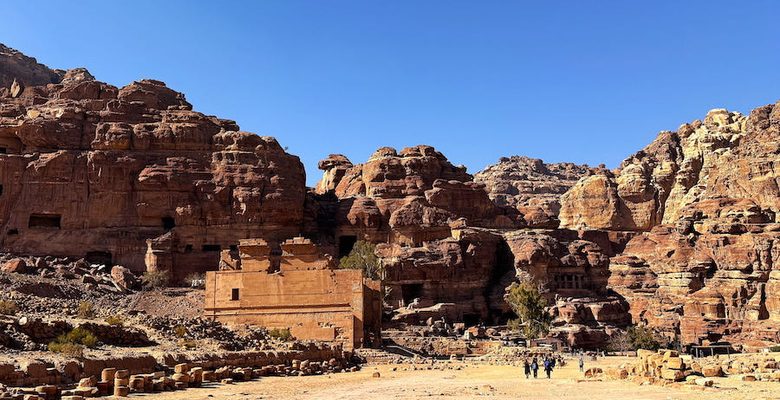
Architectural gems skilfully sculpted into red sandstone cliffs; soaring crags honeycombed with mysterious, empty caves; carved stone remains of Roman occupation; and a bizarre desert landscape flecked with a few colourfully adorned camels, donkeys and horses. This is Petra.
History of Petra
Built about 300 BCE by the Nabataeans as their capital, its location between the Red Sea and the Dead Sea made it a vital stop on the trading route between Egypt and Arabia and the Mediterranean Sea. It became so important that in 106 AD, Emperor Trajan, anxious to spread Rome’s influence, annexed it as his new province of Arabia Petraea.
One might have expected that this thriving city in the centre of international commerce would have become famous throughout Europe. But, although it was visited by Crusaders in the 12th century AD, Petra was virtually unknown to those outside these lands until 1812, when it was ‘discovered’ by a Swiss explorer, Johann Ludwig Burckhardt. It wasn’t long before the curious and archaeologist wannabes of Europe made the trek to see it. In 1845, British poet John William Burgon, described it as “a rose-red city half as old as time,” and the sobriquet stuck.
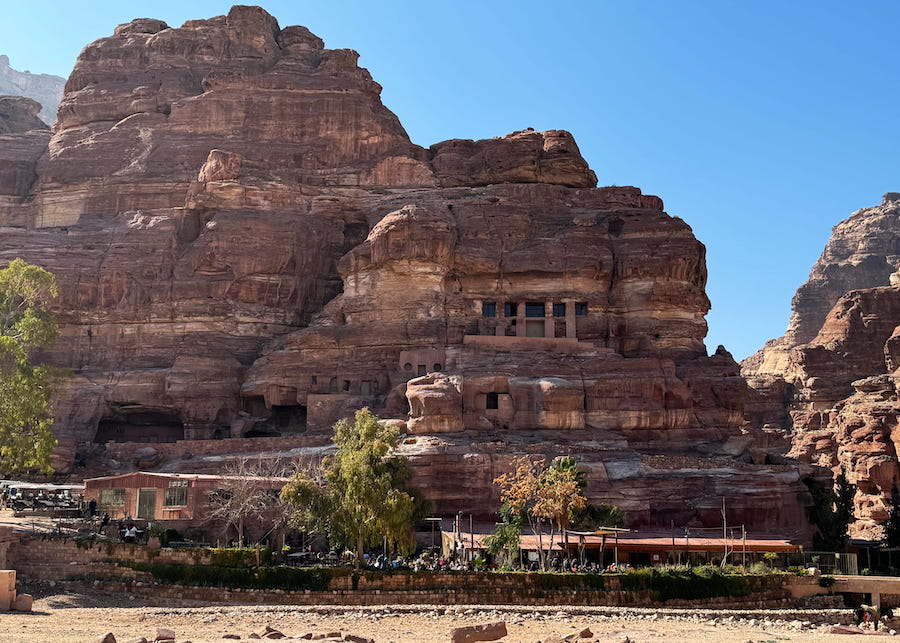
Serious interest in the ancient city followed the 1985 declaration of Petra as a UNESCO World Heritage Site. Today, the Rose Red City is on the list of the New Seven Wonders of the World, iconic landmarks representing humanity’s greatest architectural and cultural achievements. UNESCO describes Petra as “one of the most precious cultural properties of man’s cultural heritage.”
Petra is indeed a remarkable achievement, particularly for a nomadic people used to a peripatetic existence. The Nabataeans patently had formidable engineering and architectural skills and put them to use to build their capital. They sculpted magnificent buildings, and created water distribution channels ending in enormous reservoirs and cisterns, many hidden to protect them from sabotage. These enabled them to live comfortably in a very inhospitable land.
Petra stands at the edge of Wadi Musa, or the Valley of Moses; it was here that the Biblical leader was said to have struck a rock from which water poured forth. The desert here is certainly remarkable. Cliffs and rocks have been formed of ancient sandstone, tumbled by storms, wind, and earthquakes into bizarre landscapes. In these outlandish shapes run coloured bands of rich red, deep purple, and yellows ranging from bright canary to palest beige. They are a natural phenomenon called Liesegang rings, but their scientific name doesn’t detract from the otherworldliness of this land which has appeared in numerous films as other planets. Nearby Wadi Rum is often referred to as the Valley of the Moon.
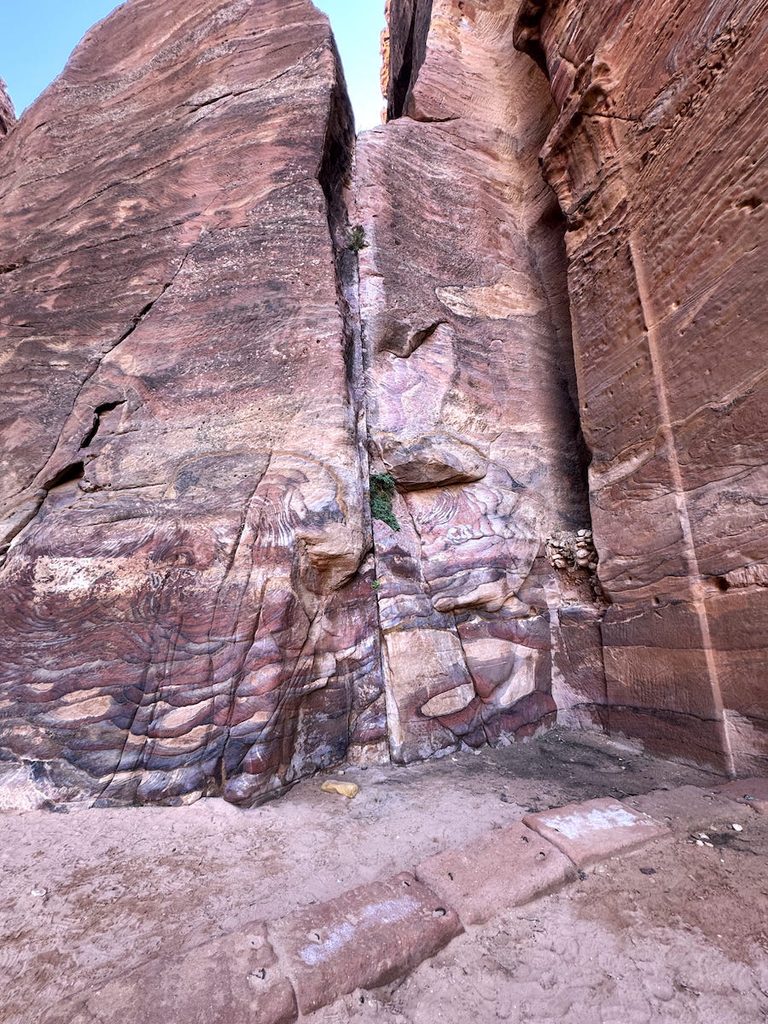
Inside the Rose Red City Today
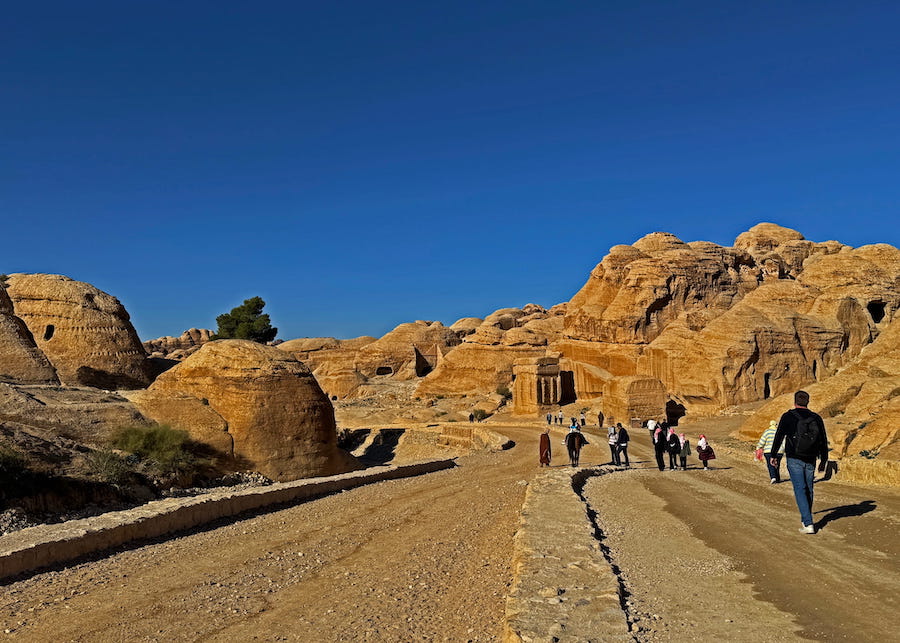
Entering Petra from the Visitor Centre, our route takes us past these curious desert rock formations, as well as giving us our first view of crude Nabataean buildings – a taste of what’s in store ahead.
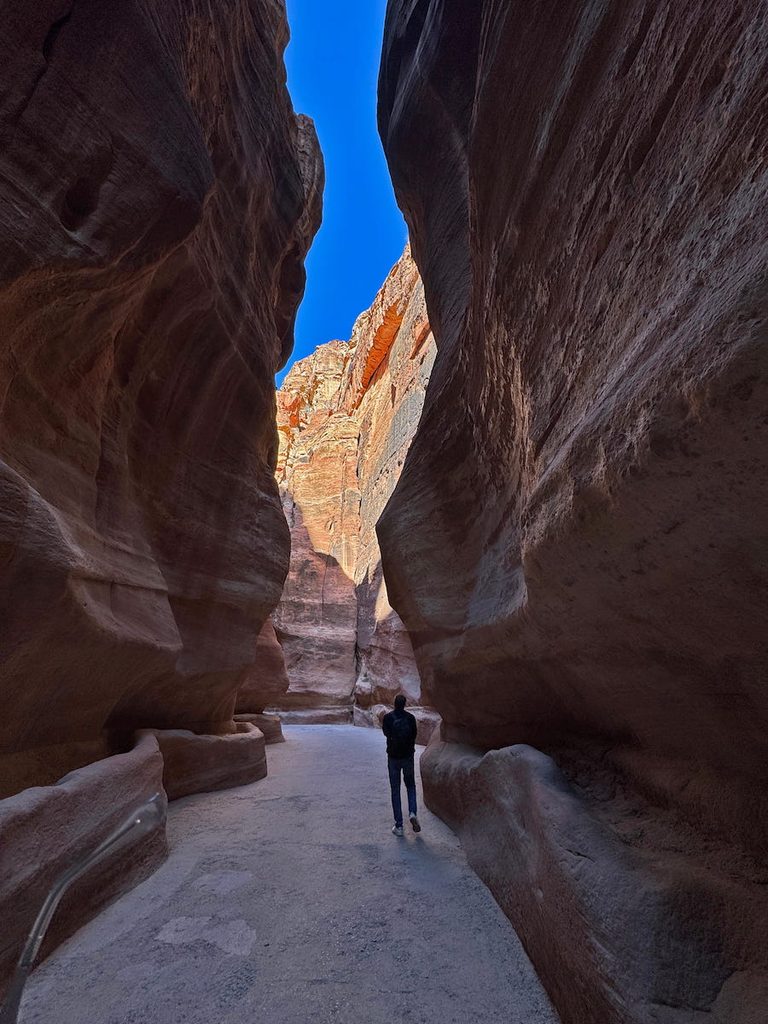
Our progress quickly becomes positively breathtaking as we enter Al Siq, a 1.2 km long gorge. This, along with the wild landscape, is a significant part of Mother Nature’s contribution to Petra. Walking through this pathway, one cannot help but be awestruck at the tectonic forces which cleaved the massif to create this passage through solid rock, before it was sculpted by water and wind. Along its length, multihued walls, some more than 80 metres high, tower dramatically overhead. Chiselled water channels run along their sides, signs of human endeavour. We even pass the tumbled remains of a sculpture.
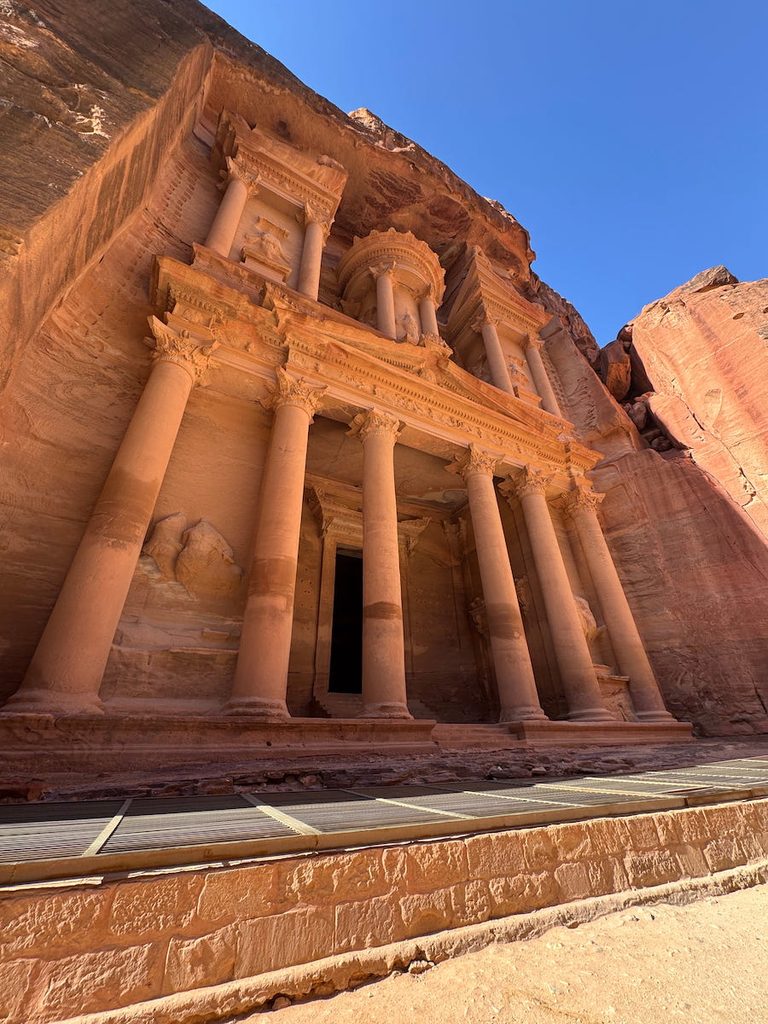
At the end of this tour de force of nature, we encounter our first example of exceptional human creativity. Before us is Al Khazneh. It’s doubtful that a single story has been written about Petra without accompanying photos of this building. It might also be familiar, having been featured in movies like Indiana Jones and the Last Crusade, Aladdin, Lawrence of Arabia, and more.
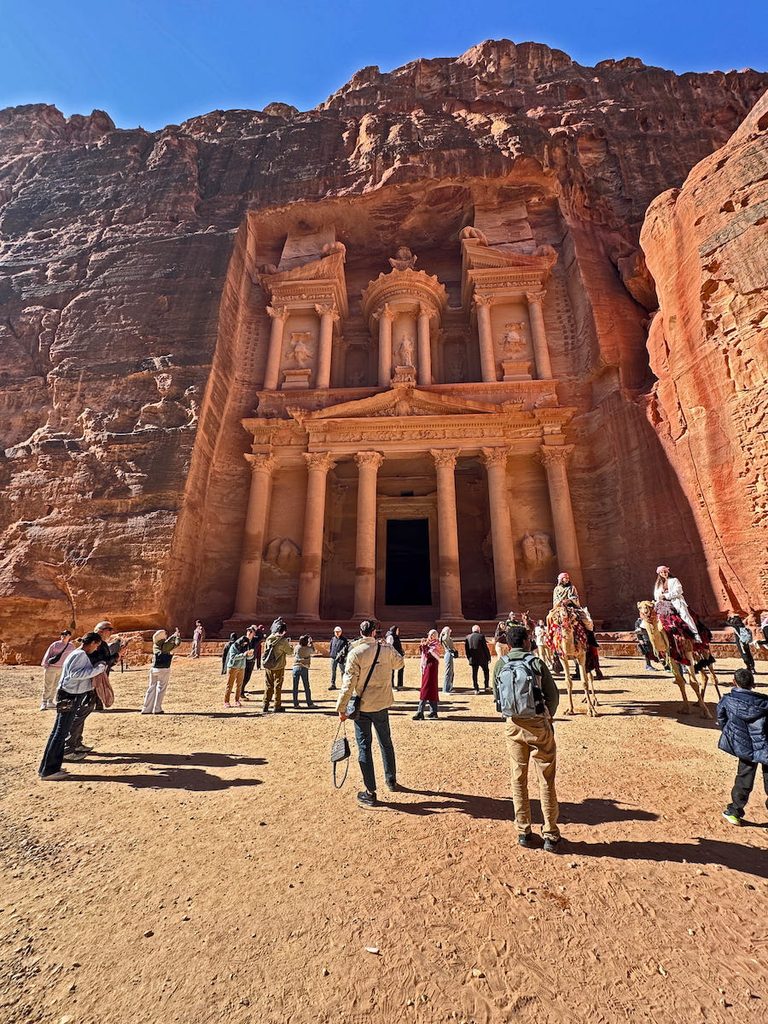
Carved deep into red sandstone cliffs, this impressive edifice has the figures of Castor and Pollux standing on either side of the entrance. Most of the figures carved in the niches appear to relate to the afterlife as it was probably intended as a mausoleum for the Nabataean king, Aretas IV. Not unnaturally, it was assumed that vast treasure must have been buried with him. Hence its name, which translates to ‘The Treasury’. A large funerary urn adorning the top is damaged and shows many bullet holes, apparently the result of thieves trying to find the treasure. Unfortunately, many decades of fruitless searching have unearthed neither gold nor jewels, though as recently as 2024, twelve bodies were discovered under the building.
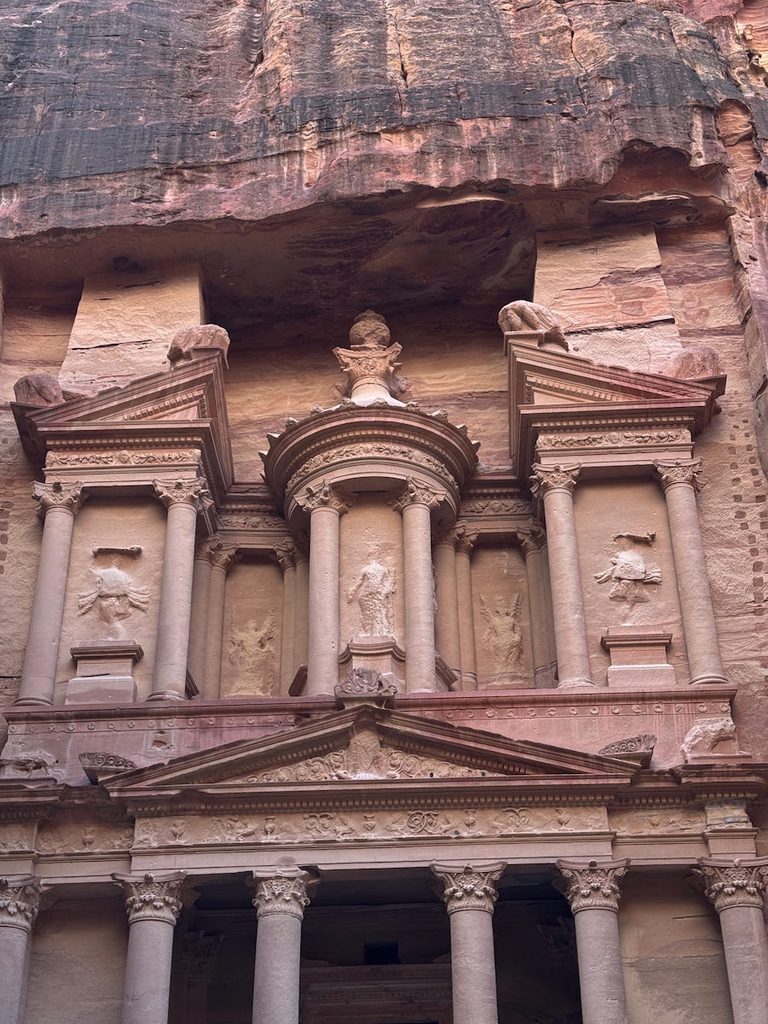
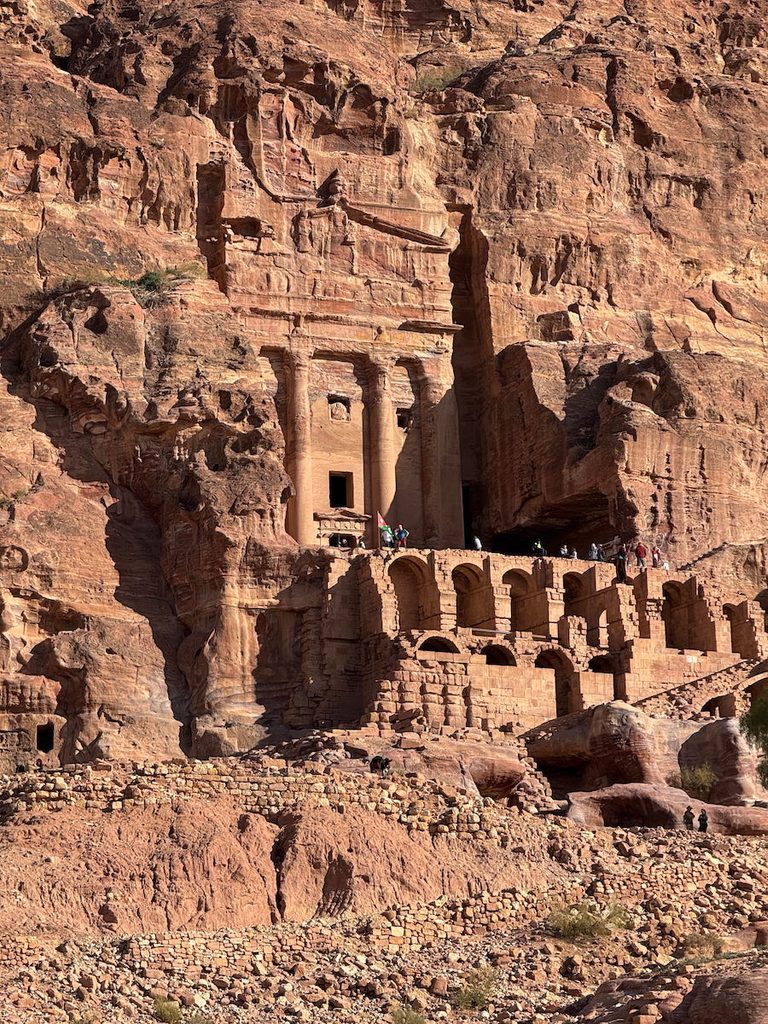
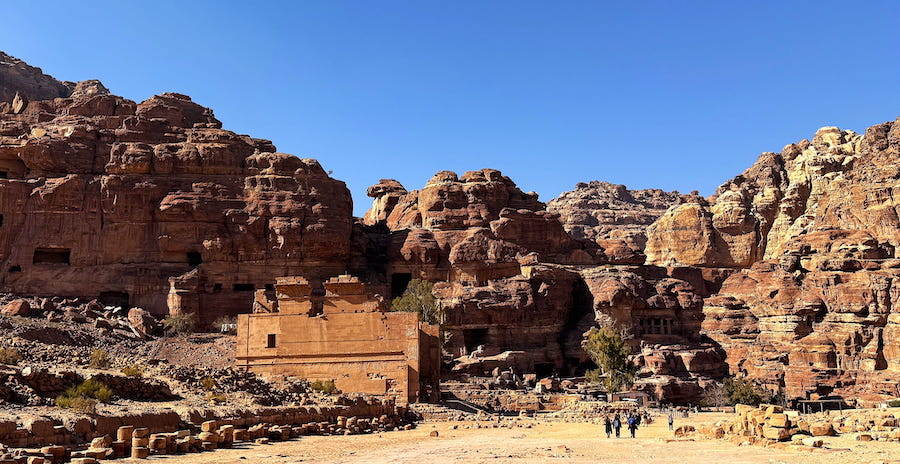
Al Khazneh is our introduction to Petra – and its undoubtedly compelling – but this ancient city offers much more. Moving on into the centre of this huge complex is a head-turning exercise. In every direction, rising walls of red sandstone have been carved and chiselled. More buildings emerge from the cliffs, while steep stairs rise to vast cavities, often handsomely framed by sculpted stone lintels. Many of these were tombs; some are even labelled Royal Tombs. All appear to be empty.
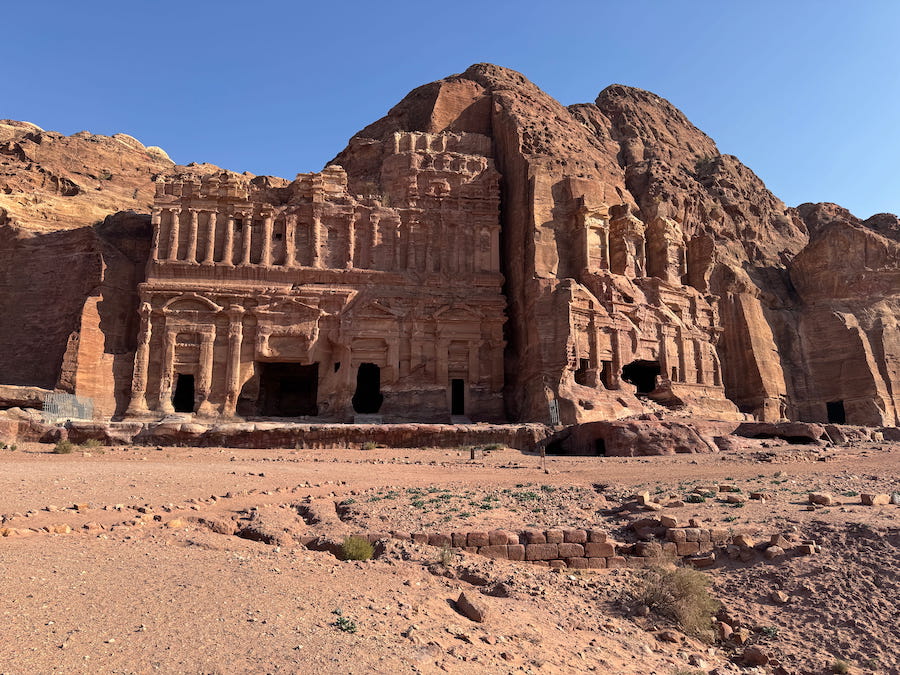
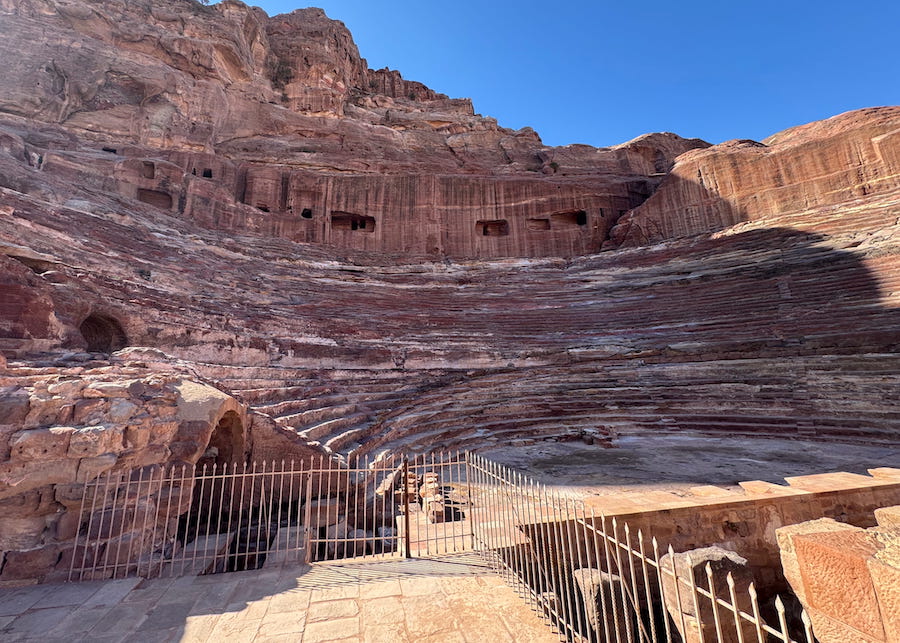
In the city centre, a vast amphitheatre, carved directly into the mountainside and able to accommodate more than 6,000 people, was first built 2000 years ago by the Nabataeans. Parts of it were later reconstructed by the Romans who added a great many more buildings of their own to Petra. Indeed, their tenure left behind the tumbled remains of temples, a grand colonnade, a massive gate, and more.
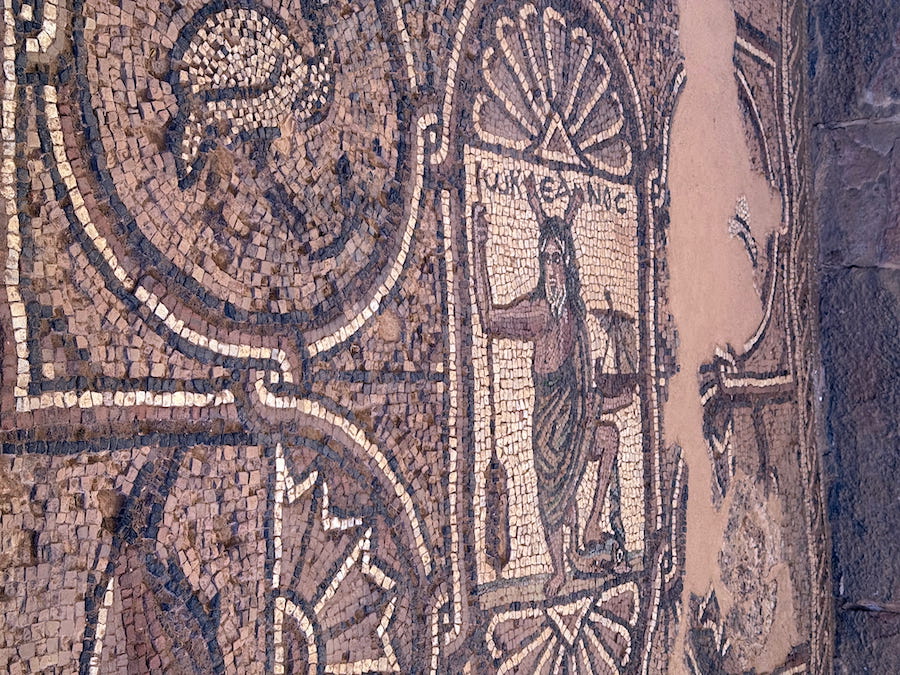
Climb the hill opposite the colonnade to the remains of a 5th century Byzantine church, whose impressive mosaics depicting animals, people, pottery, and plants, are being carefully conserved. Two centuries later Muslim Arabs would bring Islam to this area.
A day isn’t enough, especially if you wish to explore Ad-Dayr (the Monastery)
It must be said that visiting all of Petra isn’t really possible in one day. Indeed, it is difficult to accomplish it all in two days. And to see it on foot requires stamina. There are, of course, alternatives in the form of buggies, carriage rides, donkeys, horses, and camels. Even with these aids, reaching some places within the city can be very challenging.
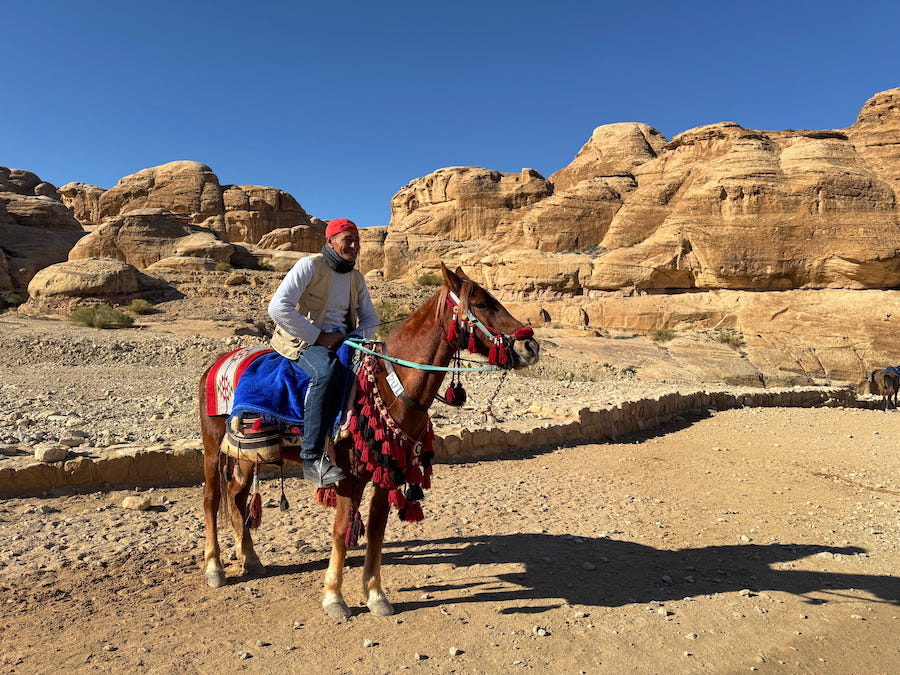
Perhaps the most demanding is Ad-Dayr, The Monastery, the other iconic Nabataean building in Petra. Located in the northwest part of the complex, at the top of a very steep cliff, it can be reached only by climbing from either the city centre or by starting at Siq Al-Barid (Little Petra), some seven kilometres north. Either route entails climbing more than 800 steps.
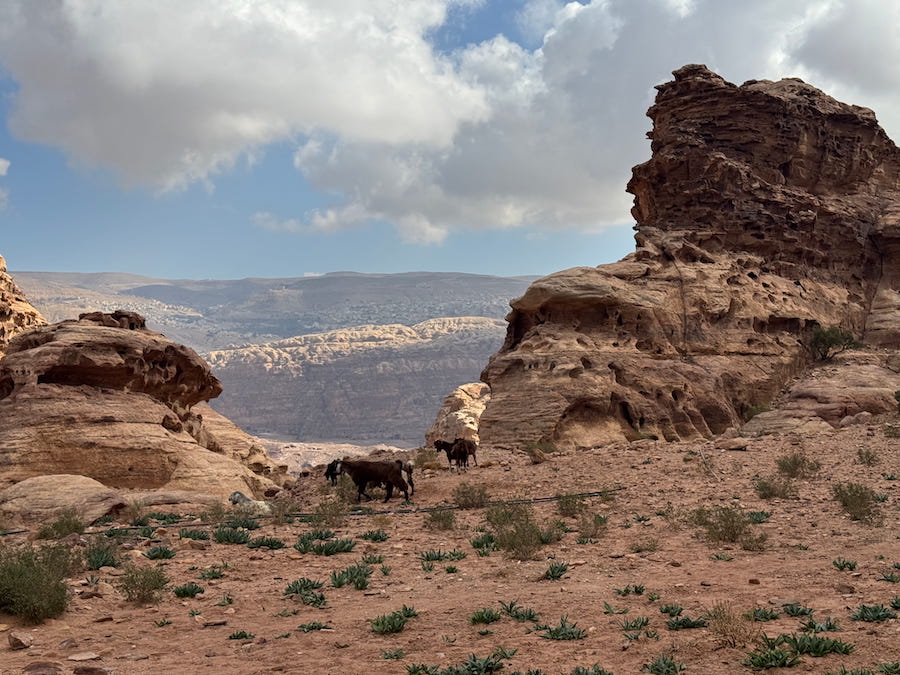
We chose to start at the latter. There is a free (very uncomfortable) shuttle to Little Petra from the Visitor’s Centre. This back door of the main city was a stopping point for caravans taking the Silk Road to trade salt, spices, and incense for silk. Often ignored by visitors, this suburb is striking. As in the main city, nature has carved a narrow path between cliffs so that one enters through a much smaller version of Al Siq, Siq Al-Barid.
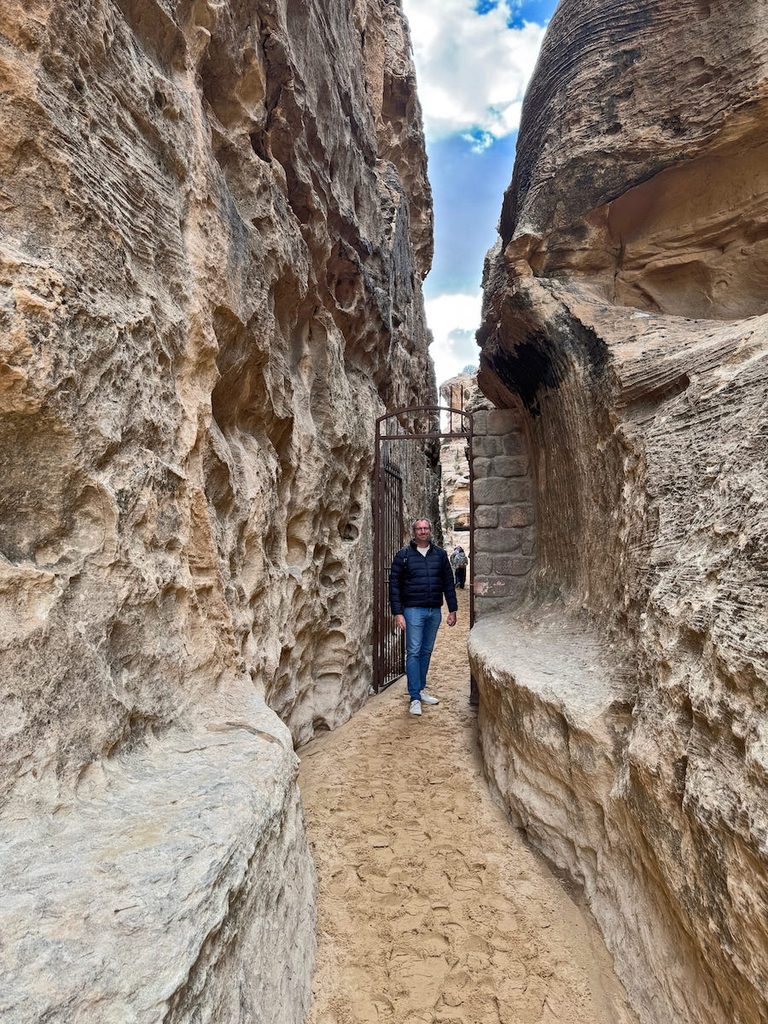
Siq Al-Barid (Little Petra)
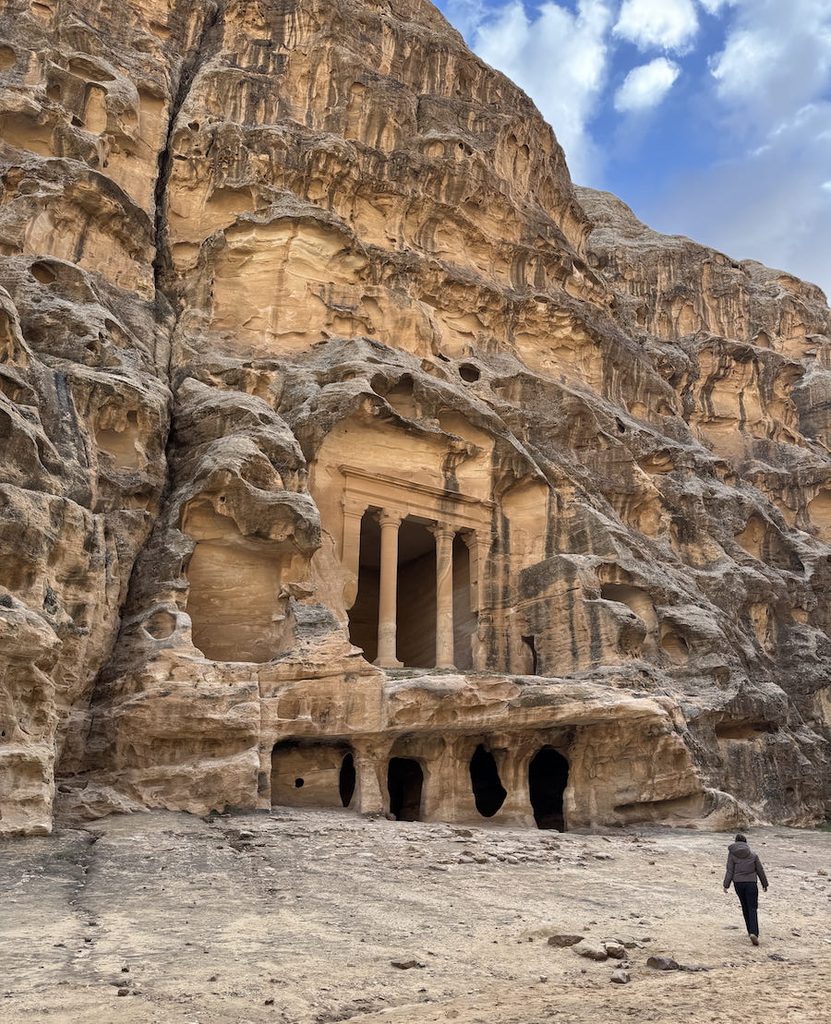
Inside Siq Al-Barid, stairs are everywhere, leading up to hollows in the cliffs. Some are tombs, others are the remains of temples and buildings carved into the sandstone.
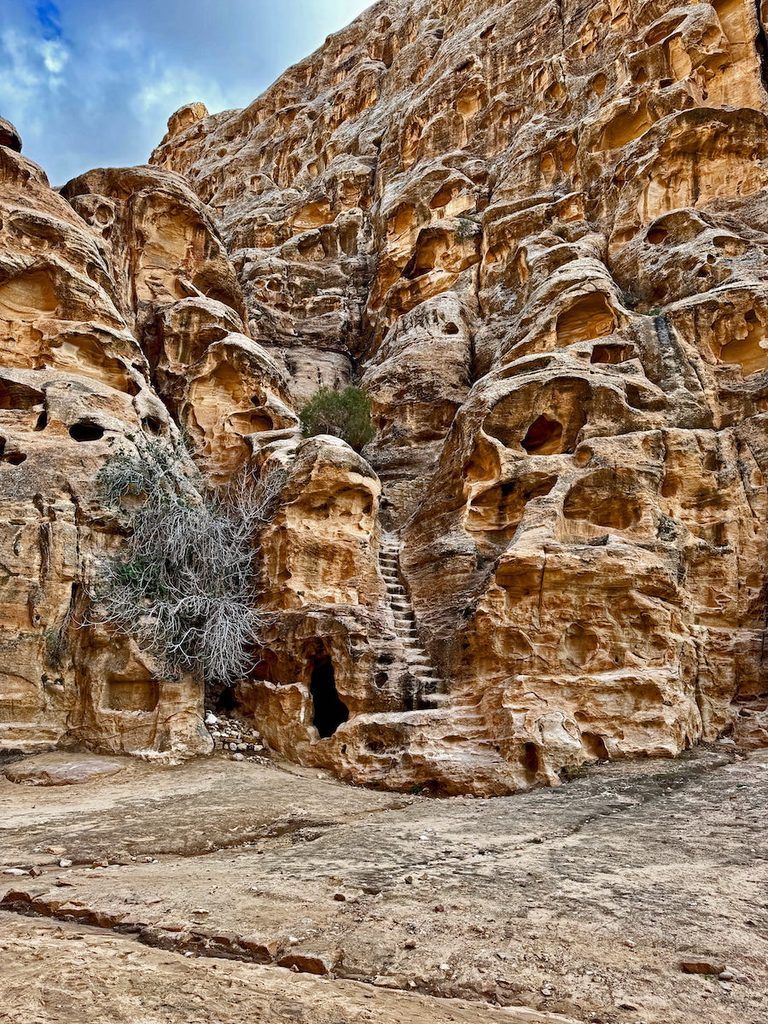
There are communal dining areas and the inevitable suqs (markets); these were undoubtedly gathering places. But in Little Petra, the bizarre rock formations are awe-inspiring. Though there are no written descriptions, one can’t help but wonder what those early caravan merchants made of this capricious landscape.
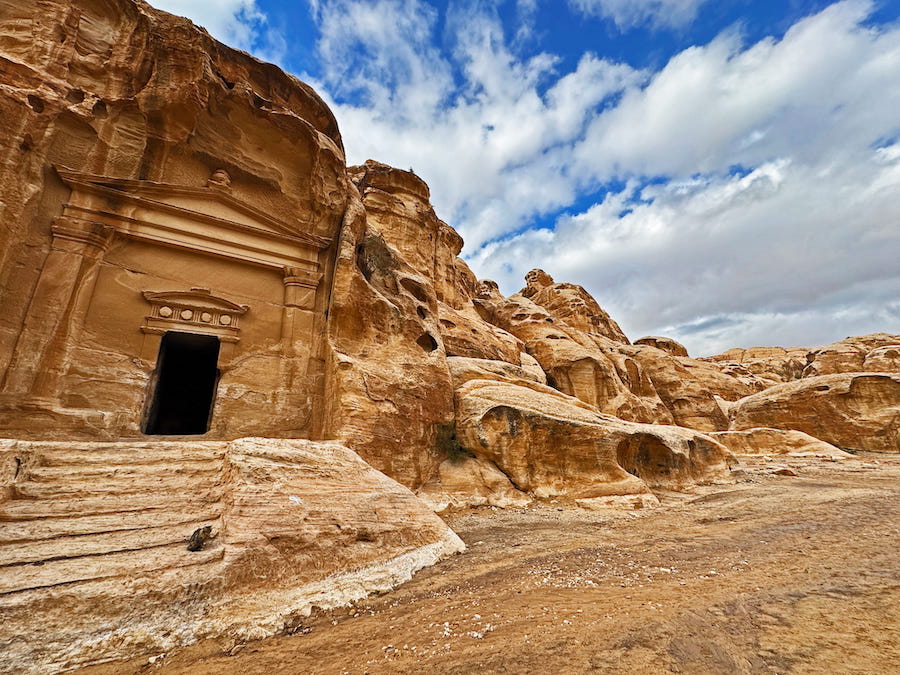
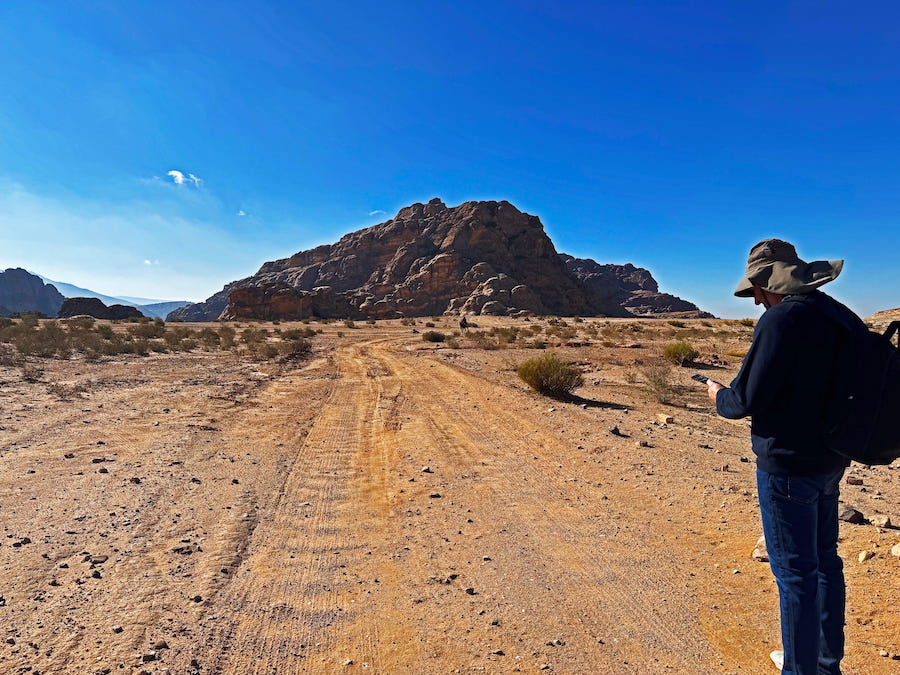
From Little Petra, though there is another shuttle available for the seven kilometre trip to the base of the first set of steps to reach Ad-Dayr. We chose to hike. One good reason for doing this is to explore more of the Al Bayda archaeological area, beyond Siq Al-Barid. This included a stop on the way to Ad-Dayr at the rough remains of Al Beydha, a Neolithic village. According to archaeologists, it is estimated to date to 7,000 BC. It seems there were nomadic peoples living here for many centuries before the Nabataeans.
The Bedouin
En route we encountered several Bedouin as we passed their huge tents in the distance. Many Bedouin once made their homes in the empty caves of Petra, but the government of Jordan has moved most to Umm Sayhoun, a new town created for them. Though they are no longer permitted to live in the caves, many have opted to continue a semi-nomadic life in the desert, making their living selling souvenirs, small trinkets and clothing, and even carpets to tourists. The women often appeal to other women, suggesting, “Women helping women, madam.” It’s an effective sentiment.
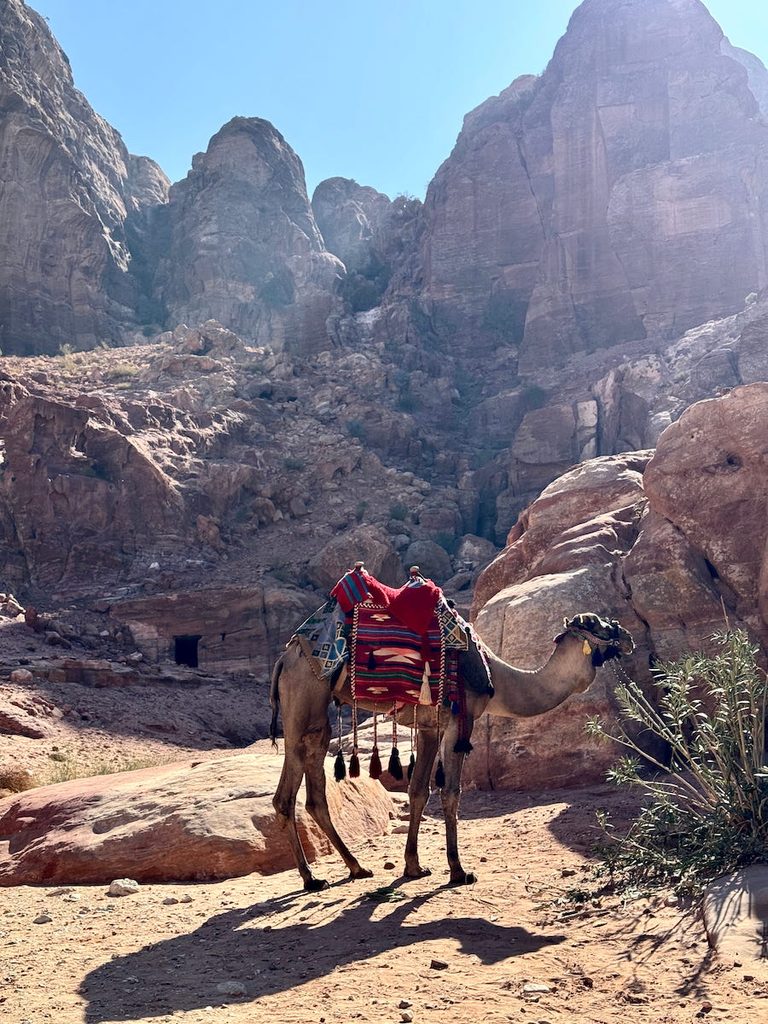
A particularly charming Bedouin gentleman we met as we hiked past near his tent, was Ahmed. He kindly showed us a much appreciated shortcut. When we reached the top of a hill, which turned out to be only the first of three very steep hills, he reappeared with two donkeys. It wasn’t too hard to give in to his gentle coaxing and agree to ride instead.
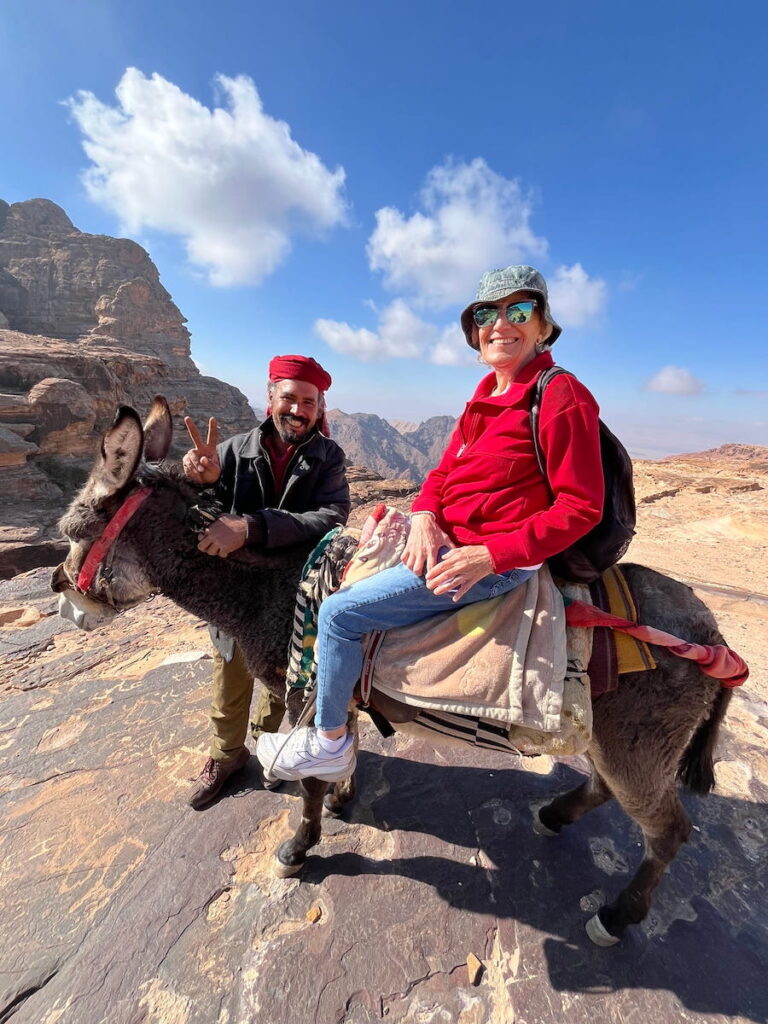
Would I recommend this method of reaching Ad-Dayr? I would, but not to the faint-hearted. It is distinctly less exhausting (unless you count the effort required to hang tightly onto the haunches of a swaying beast). But it is positively terrifying. Donkeys are surefooted, but I found I couldn’t look down at my beast’s feet negotiating their slippery way up and down hundreds of steps cut into the rock. I simply looked out from the steep precipices we passed and admired the landscape, telling myself I was saving my energy for the last climb which the donkeys would not be doing. And thus, we disembarked from our desert transport and arrived on foot at Ad-Dayr.
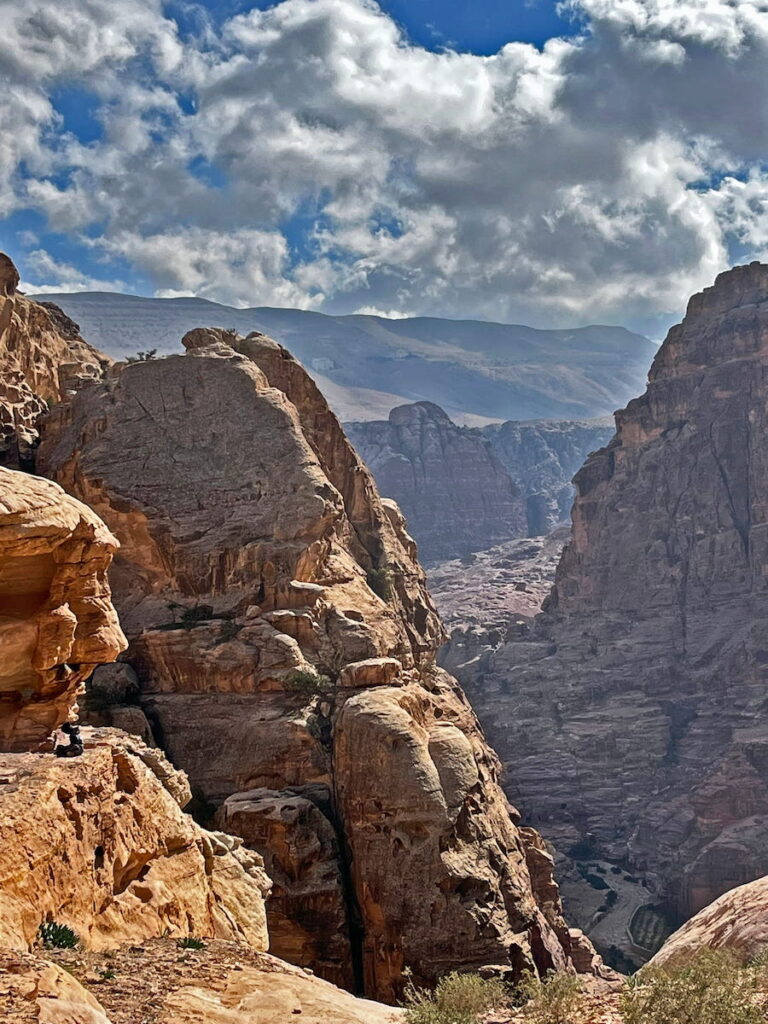
Ad-Dayr (The Monastery)
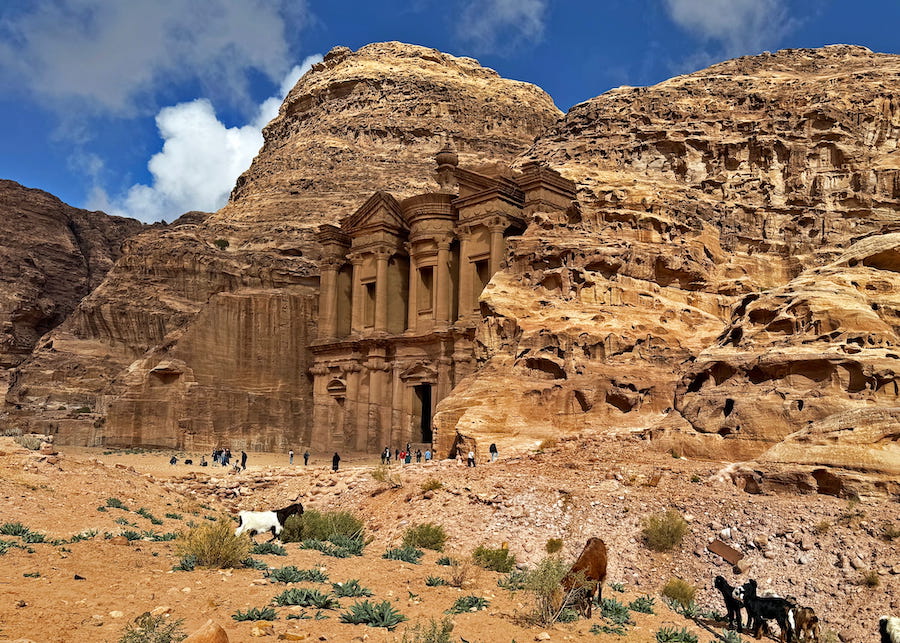
At 160 feet tall and 148 feet wide, Ad-Dayr is even grander and more imposing than Al Khazneh (the Treasury). And the building, mainly in the Nabataean style with a large urn atop its conical roof, seems to be remarkably well preserved. The name seems curious as it was apparently built in the first century AD as a temple dedicated to Nabataean King Obodas I. However, the advent of Christianity under Roman rule meant that it was probably used as a church or hermitage. Entry into the building is forbidden, but apparently there are crosses carved inside which support this conclusion.
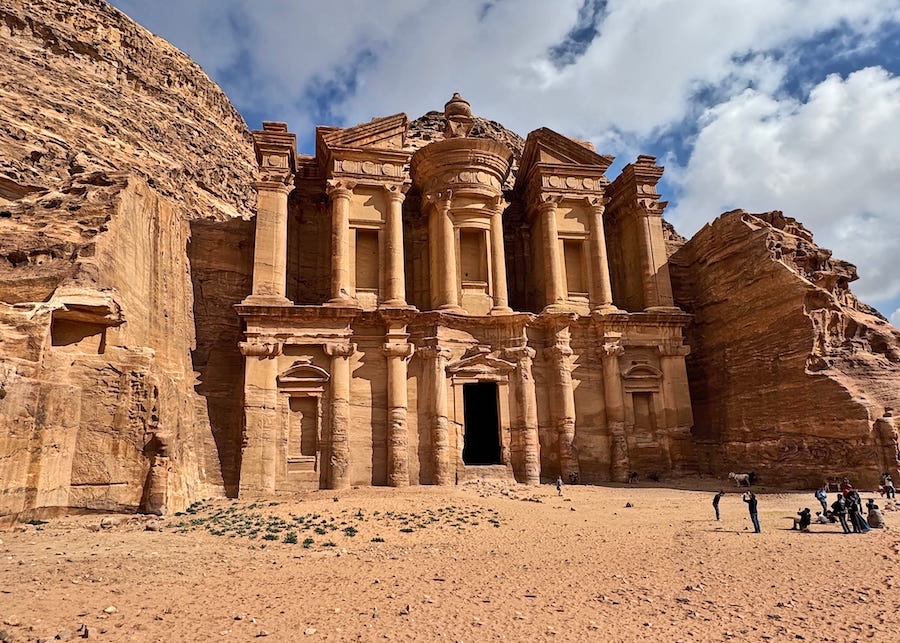
The onerous trip up repays itself in spades. The views from this high spot are truly magnificent, and a bonus is that its remoteness means that there are not the same crowds as one finds lower down in the main city. A stop at the little café opposite provides refreshment while one enjoys a wonderful view of the whole building and the herd of goats grazing around it. Of course, ahead of us there are hundreds of stairs back to the city centre, but this time, they are nearly all down!
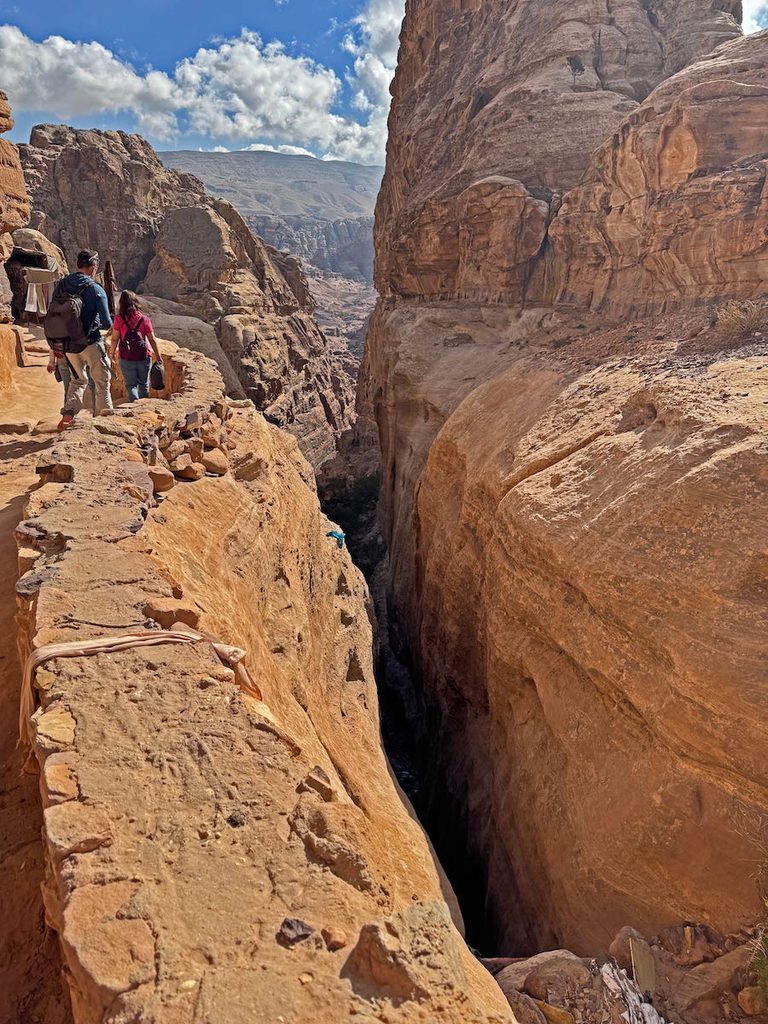
Petra is a remarkable city in a remarkable landscape. UNESCO definitely got it right in its description. But it’s notable that of the Seven New Wonders of the World, this one is singular in being the product of several very different civilizations. Nabataeans, Greeks, Romans, and Islamic Arabs, each distinctly different, have had a hand in its evolution. Even more remarkably, Petra is the only Wonder whose creation is the result not simply of human endeavour. It is, uniquely, the consummation of nature and humanity in inexplicable but glorious accord.
Where to Stay in Petra, Jordan
Planning a visit to Petra, Jordan?
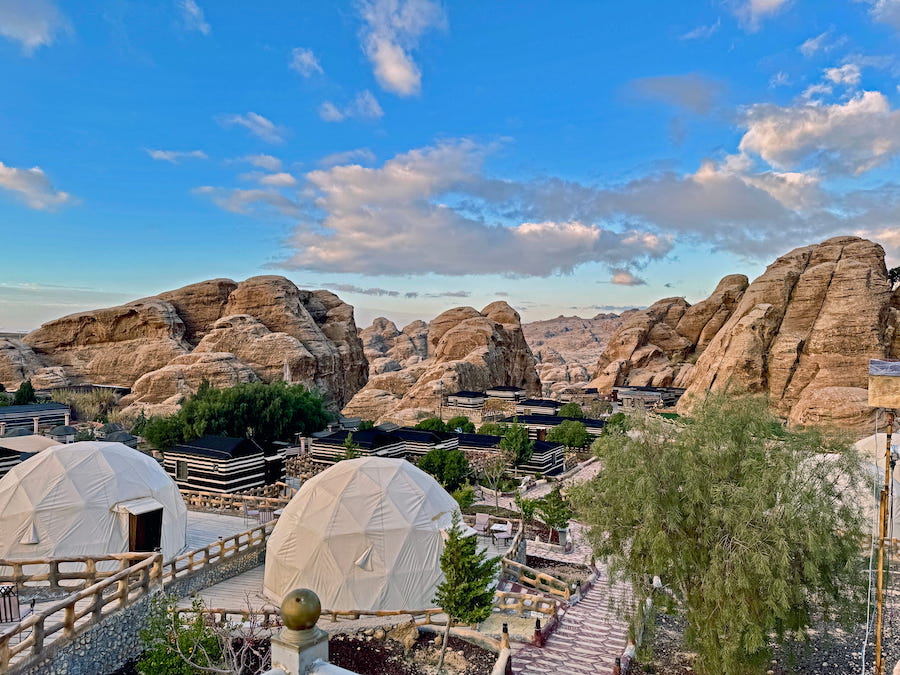
During her stay in Petra, Liz stayed at the Seven Wonders Luxury Camp pictured above, which was a luxurious accommodation. Each spacious domed tent has a comfortable queen-sized bed and private bathroom. Buffet breakfast and dinner are served in the dining room, with entertainment available in a gathering tent. The desert setting is spectacular. The camp is a 20 minute walk from Little Petra and a 10 minute drive to the Museum and entrance to Petra.
You can also check out the interactive map below for other accommodations available in Petra, Jordan.
Unless otherwise denoted in the caption, all the images in this article were photographed by Liz Campbell.
Disclaimer: There are affiliate links in this post. If you make a purchase after clicking on one of these links, we may receive a small commission at no extra cost to you. This commission contributes to paying our writers for their storytelling.

A most fascinating article
Such details of the rugged landscape and the history of the area.
Amazing photo of the author on her donkey.
Enjoyable reading.